
Introduction
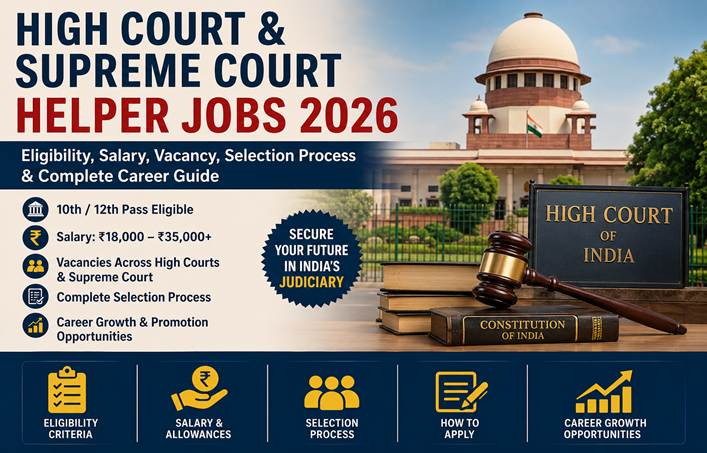
Government jobs continue to be one of the most preferred career choices in India because they offer job security, attractive salaries, career growth, pension-related benefits (where applicable), and a stable work-life balance. Among the various government departments, the Indian judiciary is highly respected for its transparency, professionalism, and employment opportunities. Every year, High Courts across different states and the Supreme Court of India release recruitment notifications for various support staff positions, creating excellent opportunities for candidates who have completed their 10th or 12th standard.
If you are searching for High Court and Supreme Court Helper Jobs 2026, this comprehensive guide will help you understand everything you need to know. From eligibility criteria and educational qualifications to salary, selection process, job responsibilities, expected vacancies, and preparation tips, this article covers every important aspect.
Although many candidates search online using the term “Helper Jobs,” the official recruitment notifications issued by different High Courts and the Supreme Court may use different post names. These include Helper, Office Attendant, Peon, Chamber Attendant, Process Server, Office Subordinate, Court Attendant, Watchman, Sweeper, and other Group C or Group D support staff positions. The exact designation depends on the recruitment rules of the respective court.
Working in the judiciary offers more than just a stable government job. It provides an opportunity to become part of India’s legal system while enjoying regular promotions, fixed working hours, paid leave, medical facilities, and various employee benefits. These jobs are particularly suitable for candidates looking for secure government employment without requiring a university degree.
Whether you are a fresh 10th-pass candidate, a 12th-pass job seeker, or someone preparing for government examinations, this guide will provide all the information you need to understand the recruitment process and prepare effectively for upcoming High Court and Supreme Court Helper Jobs in 2026.
What Are High Court and Supreme Court Helper Jobs?
High Court and Supreme Court Helper Jobs refer to support staff positions that help courts perform their day-to-day administrative and operational functions efficiently. These employees ensure smooth functioning of court offices by assisting judges, court officials, administrative staff, and visitors.
Unlike judicial officers or clerical staff, helper-level employees focus on office support, document handling, file movement, maintenance, and general assistance. These positions are considered entry-level government jobs and are ideal for candidates who wish to begin their careers in the judiciary.
Depending on the court, similar positions may include:
- Helper
- Office Attendant
- Chamber Attendant
- Peon
- Court Attendant
- Office Subordinate
- Process Server
- Watchman
- Sweeper
- Multi-Tasking Staff (MTS)
Although the job titles differ, their primary objective remains the same—supporting the smooth functioning of court administration.
Why Choose a Career in the Indian Judiciary?
Working in the judiciary offers numerous advantages that make these jobs highly competitive.
Some of the major benefits include:
- Permanent government employment
- Excellent job security
- Attractive monthly salary
- Regular salary increments
- Medical benefits
- Paid holidays
- Pension and retirement benefits as per government rules
- Fixed office timings
- Professional work environment
- Opportunities for departmental promotion
Many candidates choose judiciary jobs because they provide long-term career stability with comparatively lower work pressure than several other government departments.
High Court Helper Recruitment 2026
Every High Court in India conducts recruitment independently according to its staffing requirements. Therefore, vacancies, eligibility criteria, selection procedures, and educational qualifications may differ from one state to another.
Some of the High Courts that regularly recruit Group C and Group D employees include:
- Allahabad High Court
- Delhi High Court
- Bombay High Court
- Gujarat High Court
- Madras High Court
- Rajasthan High Court
- Karnataka High Court
- Punjab & Haryana High Court
- Patna High Court
- Calcutta High Court
- Kerala High Court
- Telangana High Court
- Andhra Pradesh High Court
- Odisha High Court
- Jharkhand High Court
Recruitment notifications are generally released whenever vacancies arise, and candidates must apply separately for each High Court.
Supreme Court Helper Recruitment 2026
The Supreme Court of India also recruits support staff from time to time. While the designation “Helper” may not always appear in official notifications, similar positions are advertised under names such as:
- Chamber Attendant
- Court Attendant
- Junior Court Assistant
- Office Attendant
- Library Attendant
- Multi-Tasking Staff
- Other support staff posts
Recruitment is conducted through transparent selection procedures, and candidates from across India can apply if they meet the eligibility requirements.
Because vacancies in the Supreme Court are comparatively fewer than in High Courts, competition is generally higher.
Expected High Court & Supreme Court Helper Vacancies 2026
The exact number of vacancies for 2026 will depend on the recruitment requirements of individual courts. However, every year, multiple High Courts collectively announce hundreds of Group C and Group D vacancies across different states.
Expected recruitment may include:
| Post | Expected Demand |
| Helper | High |
| Peon | High |
| Office Attendant | High |
| Court Attendant | Moderate |
| Chamber Attendant | Moderate |
| Process Server | High |
| Watchman | Moderate |
| Sweeper | Moderate |
| Multi-Tasking Staff | High |
Candidates should regularly monitor recruitment notifications to stay updated about vacancy announcements.
Eligibility Criteria for High Court and Supreme Court Helper Jobs 2026
Eligibility varies from one recruitment notification to another. However, most judiciary helper recruitment follows similar requirements.
- Educational Qualification
Generally, candidates should possess:
- 10th Pass from a recognized board
- 12th Pass (for certain vacancies)
- Basic reading and writing skills
- Knowledge of the local language (in some states)
Certain courts may require additional qualifications depending on the post.
- Age Limit
Most recruitment notifications follow this age structure:
- Minimum Age: 18 years
- Maximum Age: 27–35 years
Age relaxation is usually available for reserved categories according to government rules.
Typical relaxations include:
- SC/ST candidates
- OBC candidates
- Persons with Disabilities (PwD)
- Ex-servicemen
- Government employees (where applicable)
- Nationality
Applicants should generally:
- Be citizens of India.
Some notifications may include additional provisions for candidates belonging to specified categories permitted under government rules.
Skills Required for Court Helper Jobs
Although these are entry-level positions, candidates should possess certain essential qualities.
Important skills include:
- Basic communication skills
- Discipline
- Time management
- Physical fitness
- Honesty and integrity
- Ability to follow instructions
- Teamwork
- Responsibility
- File handling skills
- Professional behavior
These qualities help employees perform their duties efficiently within the judicial system.
Job Responsibilities of High Court and Supreme Court Helpers
The daily responsibilities depend upon the department and court where the candidate is posted.
Common duties include:
- Carrying official files between departments
- Assisting judges and court officers
- Maintaining office cleanliness
- Delivering documents
- Managing records
- Arranging courtrooms
- Supporting administrative staff
- Assisting visitors
- Handling office supplies
- Performing miscellaneous office duties assigned by senior officials
The work environment is generally organized, disciplined, and professional.
Salary of High Court and Supreme Court Helper Jobs 2026
Salary varies according to the recruiting court, pay level, state government rules, and allowances.
Typically, employees receive:
- Basic Pay
- Dearness Allowance (DA)
- House Rent Allowance (HRA)
- Transport Allowance (TA)
- Medical Benefits
- Leave Benefits
- Pension-related benefits (as applicable)
- Other government allowances
The approximate monthly salary generally ranges between ₹18,000 and ₹35,000, depending on the post, pay level, and applicable allowances. In some courts, the overall in-hand salary may be higher after adding admissible allowances.
Additional Benefits
Apart from salary, employees enjoy several benefits:
- Paid annual leave
- Casual leave
- Medical reimbursement
- Maternity and paternity leave (as applicable)
- Festival holidays
- Job security
- Departmental promotions
- Pension and retirement benefits under applicable rules
- Stable working hours
- Professional work environment
These benefits make judiciary jobs one of the most attractive government career options for eligible candidates.
Selection Process for High Court and Supreme Court Helper Jobs 2026
The selection process for High Court and Supreme Court Helper Jobs 2026 may vary depending on the recruiting court and the specific post. However, most High Courts and the Supreme Court follow a transparent recruitment process to ensure that qualified candidates are selected fairly.
A typical selection process includes the following stages:
1. Written Examination
Many courts conduct a written examination to assess candidates’ basic knowledge and aptitude. The exam pattern may differ from one court to another but generally includes:
- General Knowledge
- Current Affairs
- General English
- Basic Mathematics
- Reasoning Ability
- Local Language (if applicable)
The written test is usually objective in nature, although some courts may include descriptive questions for certain posts.
2. Skill Test or Practical Test
For some helper or support staff positions, candidates may have to appear for a practical or skill test. Depending on the post, this may include:
- File handling
- Physical tasks
- Office assistance demonstration
- Local language reading or writing
- Basic communication assessment
Not every recruitment includes this stage, so candidates should carefully read the official notification.
3. Interview (If Applicable)
Some High Courts may conduct a personal interview to evaluate:
- Communication skills
- Confidence
- General awareness
- Professional attitude
- Suitability for the role
However, many Group C and Group D recruitments are completed without an interview.
4. Document Verification
Candidates who qualify in the previous stages are called for document verification.
Original documents are checked to confirm eligibility and authenticity.
5. Medical Examination
The final stage generally involves a medical fitness examination to ensure that candidates are physically fit to perform the duties assigned to them.
How to Apply for High Court and Supreme Court Helper Jobs 2026
The application process is primarily online, although some courts may occasionally accept offline applications depending on the recruitment notification.
Follow these steps to apply:
Step 1: Check the Official Recruitment Notification
Read the notification carefully to understand:
- Eligibility criteria
- Educational qualification
- Age limit
- Application fee
- Important dates
- Selection process
- Required documents
Step 2: Register Online
Create a new account using:
- Mobile number
- Email ID
- Basic personal details
Step 3: Fill the Application Form
Provide accurate information regarding:
- Name
- Date of birth
- Educational qualification
- Address
- Category
- Identity proof
Step 4: Upload Documents
Generally required documents include:
- Passport-size photograph
- Signature
- Educational certificates
- Identity proof
- Category certificate (if applicable)
- Disability certificate (if applicable)
Step 5: Pay the Application Fee
Application fees vary depending on the recruiting court and the candidate’s category.
Payment can usually be made through:
- UPI
- Debit Card
- Credit Card
- Net Banking
Step 6: Submit the Application
After verifying all details, submit the application and download the confirmation page for future reference.
Documents Required
Candidates should keep the following documents ready before applying:
- Class 10 Mark Sheet and Certificate
- Class 12 Certificate (if required)
- Aadhaar Card or other valid ID proof
- Passport-size photographs
- Signature
- Caste Certificate (SC/ST/OBC)
- EWS Certificate (if applicable)
- PwD Certificate (if applicable)
- Domicile Certificate (if required)
- Experience Certificate (if applicable)
Keeping scanned copies of these documents in the prescribed format will make the online application process smoother.
Preparation Tips for High Court and Supreme Court Helper Jobs
Although helper-level examinations are generally less difficult than many competitive government exams, proper preparation can significantly improve your chances of success.
- Understand the Exam Pattern
Before starting your preparation, carefully review the latest syllabus and exam pattern for the court you are applying to.
- Build Strong Basics
Focus on subjects such as:
- General Knowledge
- Current Affairs
- Basic English
- Mathematics
- Logical Reasoning
A strong foundation in these areas will help you perform well in the written examination.
- Practice Previous Year Papers
Previous year question papers help candidates understand:
- Difficulty level
- Frequently asked topics
- Time management
- Important concepts
They also build confidence before the actual exam.
- Take Mock Tests
Regular mock tests help improve:
- Speed
- Accuracy
- Confidence
- Time management
They also highlight areas that need additional practice.
- Stay Updated with Current Affairs
Read newspapers and reliable news sources regularly to stay informed about national, international, legal, and government developments.
- Improve Communication Skills
If the recruitment process includes an interview or practical assessment, good communication skills and confidence can leave a positive impression.
Career Growth and Promotion
Many candidates believe that helper-level government jobs offer limited growth. However, this is not entirely true.
Depending on departmental rules, employees may receive promotions based on:
- Seniority
- Departmental examinations
- Performance
- Experience
- Availability of vacancies
Possible promotion paths may include:
- Senior Helper
- Office Assistant
- Record Assistant
- Senior Office Attendant
- Administrative Support Staff
- Other higher Group C positions
With dedication and experience, employees can build a stable and rewarding career in the judiciary.
Why High Court and Supreme Court Helper Jobs Are a Good Career Choice
These positions remain highly popular among government job aspirants because they offer a combination of stability, respect, and long-term benefits.
Some of the key advantages include:
- Stable government employment
- Attractive salary and allowances
- Fixed working hours
- Paid leave
- Medical facilities
- Career growth opportunities
- Professional work environment
- Job security
- Pension and retirement benefits (where applicable)
- Opportunity to work in India’s judicial system
For candidates seeking a secure and respectable career after completing their schooling, these jobs can be an excellent choice.
Common Mistakes to Avoid While Applying
Many applications are rejected because of simple errors. Avoid the following mistakes:
- Entering incorrect personal details
- Uploading unclear documents
- Missing the application deadline
- Paying the wrong application fee
- Ignoring eligibility criteria
- Providing inaccurate educational information
- Failing to review the application before submission
Double-check every detail to avoid unnecessary issues during the recruitment process.
Frequently Asked Questions (FAQs)
1. What are High Court and Supreme Court Helper Jobs?
These are support staff positions that assist in the day-to-day functioning of courts. Depending on the court, the official post name may vary and include Helper, Office Attendant, Peon, Chamber Attendant, Court Attendant, Process Server, or other Group C/Group D positions.
2. Who can apply for High Court and Supreme Court Helper Jobs 2026?
Candidates who meet the eligibility criteria mentioned in the official recruitment notification can apply. Many helper-level positions require candidates to have passed Class 10, while some may require Class 12 or additional qualifications.
3. What is the age limit?
The age limit generally ranges from 18 to 27–35 years, depending on the recruiting court and the post. Reserved categories are usually eligible for age relaxation as per government rules.
4. What is the salary of a Court Helper?
The salary varies depending on the court, pay level, and allowances. Generally, the monthly salary ranges from ₹18,000 to ₹35,000, along with benefits such as DA, HRA, TA, medical facilities, and paid leave.
5. Is there an interview for Helper posts?
Not always. Some recruitments include only a written examination and document verification, while others may also conduct a skill test or interview.
6. Is knowledge of the local language required?
Some High Courts may require candidates to know the local language of the state. The requirement, if any, will be clearly mentioned in the official notification.
7. Can candidates from any state apply?
For Supreme Court recruitment, eligible candidates from across India can usually apply. High Court recruitment rules vary by state, and some notifications may include domicile or local language requirements.
8. How can I stay updated about upcoming vacancies?
Candidates should regularly visit the official websites of the Supreme Court of India and the respective High Courts, and follow reliable government job portals for the latest recruitment notifications.
Conclusion
High Court and Supreme Court Helper Jobs 2026 present an excellent opportunity for candidates seeking secure and respected government employment. These positions offer competitive salaries, attractive allowances, fixed working hours, career growth, and the chance to work within India’s judicial system. Whether you are a 10th-pass or 12th-pass candidate, preparing in advance can significantly improve your chances of success when recruitment notifications are released.
Since each High Court conducts its own recruitment and the Supreme Court announces vacancies based on its staffing requirements, it is important to regularly check official notifications for the latest updates on eligibility, vacancies, application dates, and selection procedures. Understanding the recruitment process, gathering the necessary documents, and following a disciplined preparation strategy will help you stay ahead of the competition.
If your goal is to build a stable and rewarding government career, High Court and Supreme Court Helper Jobs 2026 are worth considering. Start preparing early, stay informed about official announcements, and focus on consistent practice to maximize your chances of securing a position in the Indian judiciary.
High Court & Supreme Court Helper Jobs 2026: Eligibility, Salary, Vacancy, Selection Process & Complete Career Guide
Introduction
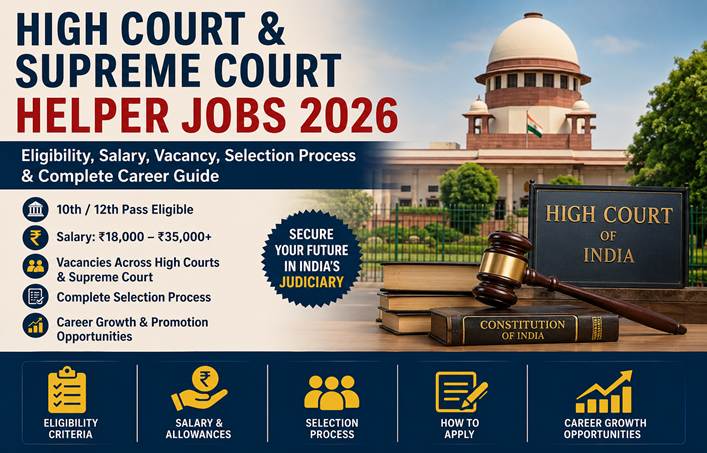
Government jobs continue to be one of the most preferred career choices in India because they offer job security, attractive salaries, career growth, pension-related benefits (where applicable), and a stable work-life balance. Among the various government departments, the Indian judiciary is highly respected for its transparency, professionalism, and employment opportunities. Every year, High Courts across different states and the Supreme Court of India release recruitment notifications for various support staff positions, creating excellent opportunities for candidates who have completed their 10th or 12th standard.
If you are searching for High Court and Supreme Court Helper Jobs 2026, this comprehensive guide will help you understand everything you need to know. From eligibility criteria and educational qualifications to salary, selection process, job responsibilities, expected vacancies, and preparation tips, this article covers every important aspect.
Although many candidates search online using the term “Helper Jobs,” the official recruitment notifications issued by different High Courts and the Supreme Court may use different post names. These include Helper, Office Attendant, Peon, Chamber Attendant, Process Server, Office Subordinate, Court Attendant, Watchman, Sweeper, and other Group C or Group D support staff positions. The exact designation depends on the recruitment rules of the respective court.
Working in the judiciary offers more than just a stable government job. It provides an opportunity to become part of India’s legal system while enjoying regular promotions, fixed working hours, paid leave, medical facilities, and various employee benefits. These jobs are particularly suitable for candidates looking for secure government employment without requiring a university degree.
Whether you are a fresh 10th-pass candidate, a 12th-pass job seeker, or someone preparing for government examinations, this guide will provide all the information you need to understand the recruitment process and prepare effectively for upcoming High Court and Supreme Court Helper Jobs in 2026.
What Are High Court and Supreme Court Helper Jobs?
High Court and Supreme Court Helper Jobs refer to support staff positions that help courts perform their day-to-day administrative and operational functions efficiently. These employees ensure smooth functioning of court offices by assisting judges, court officials, administrative staff, and visitors.
Unlike judicial officers or clerical staff, helper-level employees focus on office support, document handling, file movement, maintenance, and general assistance. These positions are considered entry-level government jobs and are ideal for candidates who wish to begin their careers in the judiciary.
Depending on the court, similar positions may include:
- Helper
- Office Attendant
- Chamber Attendant
- Peon
- Court Attendant
- Office Subordinate
- Process Server
- Watchman
- Sweeper
- Multi-Tasking Staff (MTS)
Although the job titles differ, their primary objective remains the same—supporting the smooth functioning of court administration.
Why Choose a Career in the Indian Judiciary?
Working in the judiciary offers numerous advantages that make these jobs highly competitive.
Some of the major benefits include:
- Permanent government employment
- Excellent job security
- Attractive monthly salary
- Regular salary increments
- Medical benefits
- Paid holidays
- Pension and retirement benefits as per government rules
- Fixed office timings
- Professional work environment
- Opportunities for departmental promotion
Many candidates choose judiciary jobs because they provide long-term career stability with comparatively lower work pressure than several other government departments.
High Court Helper Recruitment 2026
Every High Court in India conducts recruitment independently according to its staffing requirements. Therefore, vacancies, eligibility criteria, selection procedures, and educational qualifications may differ from one state to another.
Some of the High Courts that regularly recruit Group C and Group D employees include:
- Allahabad High Court
- Delhi High Court
- Bombay High Court
- Gujarat High Court
- Madras High Court
- Rajasthan High Court
- Karnataka High Court
- Punjab & Haryana High Court
- Patna High Court
- Calcutta High Court
- Kerala High Court
- Telangana High Court
- Andhra Pradesh High Court
- Odisha High Court
- Jharkhand High Court
Recruitment notifications are generally released whenever vacancies arise, and candidates must apply separately for each High Court.
Supreme Court Helper Recruitment 2026
The Supreme Court of India also recruits support staff from time to time. While the designation “Helper” may not always appear in official notifications, similar positions are advertised under names such as:
- Chamber Attendant
- Court Attendant
- Junior Court Assistant
- Office Attendant
- Library Attendant
- Multi-Tasking Staff
- Other support staff posts
Recruitment is conducted through transparent selection procedures, and candidates from across India can apply if they meet the eligibility requirements.
Because vacancies in the Supreme Court are comparatively fewer than in High Courts, competition is generally higher.
Expected High Court & Supreme Court Helper Vacancies 2026
The exact number of vacancies for 2026 will depend on the recruitment requirements of individual courts. However, every year, multiple High Courts collectively announce hundreds of Group C and Group D vacancies across different states.
Expected recruitment may include:
| Post | Expected Demand |
| Helper | High |
| Peon | High |
| Office Attendant | High |
| Court Attendant | Moderate |
| Chamber Attendant | Moderate |
| Process Server | High |
| Watchman | Moderate |
| Sweeper | Moderate |
| Multi-Tasking Staff | High |
Candidates should regularly monitor recruitment notifications to stay updated about vacancy announcements.
Eligibility Criteria for High Court and Supreme Court Helper Jobs 2026
Eligibility varies from one recruitment notification to another. However, most judiciary helper recruitment follows similar requirements.
- Educational Qualification
Generally, candidates should possess:
- 10th Pass from a recognized board
- 12th Pass (for certain vacancies)
- Basic reading and writing skills
- Knowledge of the local language (in some states)
Certain courts may require additional qualifications depending on the post.
- Age Limit
Most recruitment notifications follow this age structure:
- Minimum Age: 18 years
- Maximum Age: 27–35 years
Age relaxation is usually available for reserved categories according to government rules.
Typical relaxations include:
- SC/ST candidates
- OBC candidates
- Persons with Disabilities (PwD)
- Ex-servicemen
- Government employees (where applicable)
- Nationality
Applicants should generally:
- Be citizens of India.
Some notifications may include additional provisions for candidates belonging to specified categories permitted under government rules.
Skills Required for Court Helper Jobs
Although these are entry-level positions, candidates should possess certain essential qualities.
Important skills include:
- Basic communication skills
- Discipline
- Time management
- Physical fitness
- Honesty and integrity
- Ability to follow instructions
- Teamwork
- Responsibility
- File handling skills
- Professional behavior
These qualities help employees perform their duties efficiently within the judicial system.
Job Responsibilities of High Court and Supreme Court Helpers
The daily responsibilities depend upon the department and court where the candidate is posted.
Common duties include:
- Carrying official files between departments
- Assisting judges and court officers
- Maintaining office cleanliness
- Delivering documents
- Managing records
- Arranging courtrooms
- Supporting administrative staff
- Assisting visitors
- Handling office supplies
- Performing miscellaneous office duties assigned by senior officials
The work environment is generally organized, disciplined, and professional.
Salary of High Court and Supreme Court Helper Jobs 2026
Salary varies according to the recruiting court, pay level, state government rules, and allowances.
Typically, employees receive:
- Basic Pay
- Dearness Allowance (DA)
- House Rent Allowance (HRA)
- Transport Allowance (TA)
- Medical Benefits
- Leave Benefits
- Pension-related benefits (as applicable)
- Other government allowances
The approximate monthly salary generally ranges between ₹18,000 and ₹35,000, depending on the post, pay level, and applicable allowances. In some courts, the overall in-hand salary may be higher after adding admissible allowances.
Additional Benefits
Apart from salary, employees enjoy several benefits:
- Paid annual leave
- Casual leave
- Medical reimbursement
- Maternity and paternity leave (as applicable)
- Festival holidays
- Job security
- Departmental promotions
- Pension and retirement benefits under applicable rules
- Stable working hours
- Professional work environment
These benefits make judiciary jobs one of the most attractive government career options for eligible candidates.
Selection Process for High Court and Supreme Court Helper Jobs 2026
The selection process for High Court and Supreme Court Helper Jobs 2026 may vary depending on the recruiting court and the specific post. However, most High Courts and the Supreme Court follow a transparent recruitment process to ensure that qualified candidates are selected fairly.
A typical selection process includes the following stages:
1. Written Examination
Many courts conduct a written examination to assess candidates’ basic knowledge and aptitude. The exam pattern may differ from one court to another but generally includes:
- General Knowledge
- Current Affairs
- General English
- Basic Mathematics
- Reasoning Ability
- Local Language (if applicable)
The written test is usually objective in nature, although some courts may include descriptive questions for certain posts.
2. Skill Test or Practical Test
For some helper or support staff positions, candidates may have to appear for a practical or skill test. Depending on the post, this may include:
- File handling
- Physical tasks
- Office assistance demonstration
- Local language reading or writing
- Basic communication assessment
Not every recruitment includes this stage, so candidates should carefully read the official notification.
3. Interview (If Applicable)
Some High Courts may conduct a personal interview to evaluate:
- Communication skills
- Confidence
- General awareness
- Professional attitude
- Suitability for the role
However, many Group C and Group D recruitments are completed without an interview.
4. Document Verification
Candidates who qualify in the previous stages are called for document verification.
Original documents are checked to confirm eligibility and authenticity.
5. Medical Examination
The final stage generally involves a medical fitness examination to ensure that candidates are physically fit to perform the duties assigned to them.
How to Apply for High Court and Supreme Court Helper Jobs 2026
The application process is primarily online, although some courts may occasionally accept offline applications depending on the recruitment notification.
Follow these steps to apply:
Step 1: Check the Official Recruitment Notification
Read the notification carefully to understand:
- Eligibility criteria
- Educational qualification
- Age limit
- Application fee
- Important dates
- Selection process
- Required documents
Step 2: Register Online
Create a new account using:
- Mobile number
- Email ID
- Basic personal details
Step 3: Fill the Application Form
Provide accurate information regarding:
- Name
- Date of birth
- Educational qualification
- Address
- Category
- Identity proof
Step 4: Upload Documents
Generally required documents include:
- Passport-size photograph
- Signature
- Educational certificates
- Identity proof
- Category certificate (if applicable)
- Disability certificate (if applicable)
Step 5: Pay the Application Fee
Application fees vary depending on the recruiting court and the candidate’s category.
Payment can usually be made through:
- UPI
- Debit Card
- Credit Card
- Net Banking
Step 6: Submit the Application
After verifying all details, submit the application and download the confirmation page for future reference.
Documents Required
Candidates should keep the following documents ready before applying:
- Class 10 Mark Sheet and Certificate
- Class 12 Certificate (if required)
- Aadhaar Card or other valid ID proof
- Passport-size photographs
- Signature
- Caste Certificate (SC/ST/OBC)
- EWS Certificate (if applicable)
- PwD Certificate (if applicable)
- Domicile Certificate (if required)
- Experience Certificate (if applicable)
Keeping scanned copies of these documents in the prescribed format will make the online application process smoother.
Preparation Tips for High Court and Supreme Court Helper Jobs
Although helper-level examinations are generally less difficult than many competitive government exams, proper preparation can significantly improve your chances of success.
- Understand the Exam Pattern
Before starting your preparation, carefully review the latest syllabus and exam pattern for the court you are applying to.
- Build Strong Basics
Focus on subjects such as:
- General Knowledge
- Current Affairs
- Basic English
- Mathematics
- Logical Reasoning
A strong foundation in these areas will help you perform well in the written examination.
- Practice Previous Year Papers
Previous year question papers help candidates understand:
- Difficulty level
- Frequently asked topics
- Time management
- Important concepts
They also build confidence before the actual exam.
- Take Mock Tests
Regular mock tests help improve:
- Speed
- Accuracy
- Confidence
- Time management
They also highlight areas that need additional practice.
- Stay Updated with Current Affairs
Read newspapers and reliable news sources regularly to stay informed about national, international, legal, and government developments.
- Improve Communication Skills
If the recruitment process includes an interview or practical assessment, good communication skills and confidence can leave a positive impression.
Career Growth and Promotion
Many candidates believe that helper-level government jobs offer limited growth. However, this is not entirely true.
Depending on departmental rules, employees may receive promotions based on:
- Seniority
- Departmental examinations
- Performance
- Experience
- Availability of vacancies
Possible promotion paths may include:
- Senior Helper
- Office Assistant
- Record Assistant
- Senior Office Attendant
- Administrative Support Staff
- Other higher Group C positions
With dedication and experience, employees can build a stable and rewarding career in the judiciary.
Why High Court and Supreme Court Helper Jobs Are a Good Career Choice
These positions remain highly popular among government job aspirants because they offer a combination of stability, respect, and long-term benefits.
Some of the key advantages include:
- Stable government employment
- Attractive salary and allowances
- Fixed working hours
- Paid leave
- Medical facilities
- Career growth opportunities
- Professional work environment
- Job security
- Pension and retirement benefits (where applicable)
- Opportunity to work in India’s judicial system
For candidates seeking a secure and respectable career after completing their schooling, these jobs can be an excellent choice.
Common Mistakes to Avoid While Applying
Many applications are rejected because of simple errors. Avoid the following mistakes:
- Entering incorrect personal details
- Uploading unclear documents
- Missing the application deadline
- Paying the wrong application fee
- Ignoring eligibility criteria
- Providing inaccurate educational information
- Failing to review the application before submission
Double-check every detail to avoid unnecessary issues during the recruitment process.
Frequently Asked Questions (FAQs)
1. What are High Court and Supreme Court Helper Jobs?
These are support staff positions that assist in the day-to-day functioning of courts. Depending on the court, the official post name may vary and include Helper, Office Attendant, Peon, Chamber Attendant, Court Attendant, Process Server, or other Group C/Group D positions.
2. Who can apply for High Court and Supreme Court Helper Jobs 2026?
Candidates who meet the eligibility criteria mentioned in the official recruitment notification can apply. Many helper-level positions require candidates to have passed Class 10, while some may require Class 12 or additional qualifications.
3. What is the age limit?
The age limit generally ranges from 18 to 27–35 years, depending on the recruiting court and the post. Reserved categories are usually eligible for age relaxation as per government rules.
4. What is the salary of a Court Helper?
The salary varies depending on the court, pay level, and allowances. Generally, the monthly salary ranges from ₹18,000 to ₹35,000, along with benefits such as DA, HRA, TA, medical facilities, and paid leave.
5. Is there an interview for Helper posts?
Not always. Some recruitments include only a written examination and document verification, while others may also conduct a skill test or interview.
6. Is knowledge of the local language required?
Some High Courts may require candidates to know the local language of the state. The requirement, if any, will be clearly mentioned in the official notification.
7. Can candidates from any state apply?
For Supreme Court recruitment, eligible candidates from across India can usually apply. High Court recruitment rules vary by state, and some notifications may include domicile or local language requirements.
8. How can I stay updated about upcoming vacancies?
Candidates should regularly visit the official websites of the Supreme Court of India and the respective High Courts, and follow reliable government job portals for the latest recruitment notifications.
Conclusion
High Court and Supreme Court Helper Jobs 2026 present an excellent opportunity for candidates seeking secure and respected government employment. These positions offer competitive salaries, attractive allowances, fixed working hours, career growth, and the chance to work within India’s judicial system. Whether you are a 10th-pass or 12th-pass candidate, preparing in advance can significantly improve your chances of success when recruitment notifications are released.
Since each High Court conducts its own recruitment and the Supreme Court announces vacancies based on its staffing requirements, it is important to regularly check official notifications for the latest updates on eligibility, vacancies, application dates, and selection procedures. Understanding the recruitment process, gathering the necessary documents, and following a disciplined preparation strategy will help you stay ahead of the competition.
If your goal is to build a stable and rewarding government career, High Court and Supreme Court Helper Jobs 2026 are worth considering. Start preparing early, stay informed about official announcements, and focus on consistent practice to maximize your chances of securing a position in the Indian judiciary.