
Introduction
Every year, more than 20 lakh students compete for a limited number of medical seats through the National Eligibility cum Entrance Test (NEET). While the competition is intense, success is not determined by intelligence alone—it depends on having the right strategy, disciplined preparation, and consistent practice.
If you’re wondering how to prepare for NEET effectively, you’re in the right place. Whether you’re a Class 11 student starting early, a Class 12 student balancing board exams, or a dropper aiming for a better score, this comprehensive NEET Exam Preparation Guide will help you build a structured approach to achieve your dream of getting into a medical college.
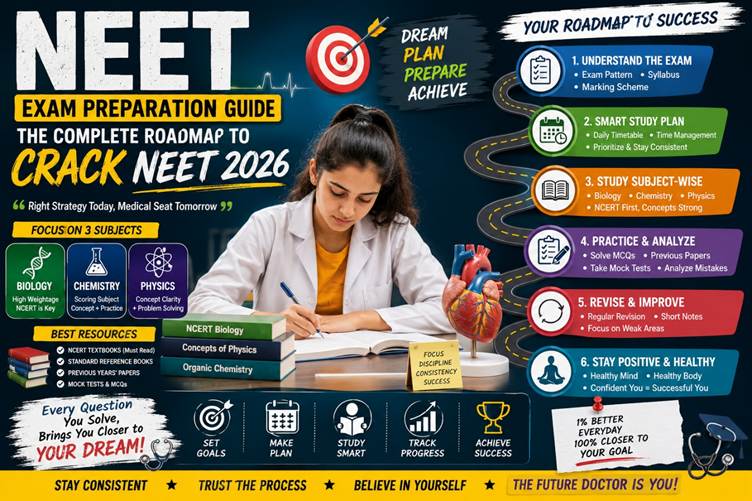
Preparing for NEET involves much more than simply reading textbooks. You need to understand the syllabus thoroughly, choose the right study materials, create an effective timetable, solve previous years’ question papers, practice mock tests regularly, and revise strategically. Many students struggle because they don’t know where to begin or how to organize their preparation. Fortunately, with the right guidance and consistent effort, anyone can significantly improve their NEET performance.
This guide covers everything you need to know—from understanding the NEET exam pattern and syllabus to choosing the best books, creating a practical study plan, managing time effectively, avoiding common mistakes, and staying motivated throughout your preparation journey. By following these expert strategies, you’ll be better equipped to maximize your score and increase your chances of securing admission to your dream medical college.
Understand the NEET Exam First
Before starting your NEET preparation, it’s important to understand the examination pattern and syllabus.
NEET is India’s single national-level entrance examination for undergraduate medical courses, including MBBS, BDS, BAMS, BHMS, BUMS, BSMS, and several allied healthcare programs.
The NEET exam consists of questions from three major subjects:
- Physics
- Chemistry
- Biology (Botany & Zoology)
NEET Exam Pattern
- Mode: Offline (Pen & Paper)
- Duration: 3 Hours
- Subjects: Physics, Chemistry, Biology
- Total Questions: 180
- Maximum Marks: 720
- Marking Scheme:
- +4 for every correct answer
- -1 for every incorrect answer
Understanding the pattern helps you prepare according to the actual examination requirements instead of studying randomly.
Know the Complete NEET Syllabus
One of the biggest mistakes students make is studying topics that are not part of the syllabus.
Your preparation should always begin with the official NEET syllabus.
The syllabus includes concepts from:
Physics
- Mechanics
- Thermodynamics
- Electricity
- Magnetism
- Optics
- Modern Physics
Chemistry
- Physical Chemistry
- Organic Chemistry
- Inorganic Chemistry
Biology
- Cell Biology
- Genetics
- Human Physiology
- Plant Physiology
- Ecology
- Biotechnology
- Evolution
- Reproduction
Always prioritize NCERT textbooks because most Biology questions are directly based on NCERT concepts.
Create an Effective NEET Study Plan
A proper study plan is one of the most important factors in cracking NEET.
Daily Study Schedule
A balanced daily routine could look like this:
- Biology – 3 Hours
- Physics – 2.5 Hours
- Chemistry – 2 Hours
- Mock Test/Practice Questions – 1 Hour
- Revision – 1.5 Hours
Remember to include short breaks to maintain focus and prevent burnout.
How to Prepare for NEET Subject-Wise
- Biology Preparation Strategy
Biology carries the highest weightage in NEET.
Focus on:
- Reading NCERT multiple times
- Making concise notes
- Learning diagrams
- Revising frequently
- Solving chapter-wise MCQs
Aim to score above 330 marks in Biology.
- Physics Preparation Strategy
Physics often feels challenging because it requires conceptual understanding and numerical problem-solving.
Tips:
- Understand concepts before memorizing formulas.
- Solve numerical problems daily.
- Practice previous years’ questions.
- Analyze your mistakes.
- Chemistry Preparation Strategy
Chemistry is a scoring subject if prepared smartly.
Physical Chemistry
- Practice numerical questions.
- Memorize formulas.
- Revise regularly.
Organic Chemistry
- Learn reaction mechanisms.
- Practice conversion questions.
- Understand named reactions.
Inorganic Chemistry
- Read NCERT thoroughly.
- Revise frequently.
- Memorize important tables and exceptions.
Best Books for NEET Preparation
Choosing the right books can simplify your preparation.
Biology
- NCERT Biology (Class 11 & 12)
- Trueman’s Biology
- MTG NCERT at Your Fingertips
Physics
- Concepts of Physics by H.C. Verma
- DC Pandey Series
- MTG Objective Physics
Chemistry
- NCERT Chemistry
- Physical Chemistry by O.P. Tandon
- Organic Chemistry by M.S. Chauhan
- Inorganic Chemistry by J.D. Lee
Avoid collecting too many books. Master a few reliable resources instead.
Importance of NCERT Books
Many NEET toppers recommend studying NCERT thoroughly because:
- Most Biology questions come directly from NCERT.
- Chemistry concepts are largely NCERT-based.
- Fundamental Physics concepts are clearly explained.
Read NCERT multiple times before moving to advanced reference books.
Solve Previous Years’ Question Papers
Previous years’ papers help you:
- Understand question patterns
- Identify important topics
- Improve speed
- Build confidence
- Reduce exam anxiety
Try solving papers in exam-like conditions.
Practice NEET Mock Tests
Mock tests are essential for success.
Benefits include:
- Time management improvement
- Accuracy enhancement
- Performance analysis
- Confidence building
- Identification of weak areas
Take at least one full-length mock test every week during the initial phase and increase the frequency as the exam approaches.
NEET Time Management Tips
Time management plays a crucial role in achieving a high score.
Effective Strategies
- Follow a fixed timetable.
- Prioritize difficult subjects.
- Avoid multitasking.
- Set daily goals.
- Track weekly progress.
- Take regular short breaks.
Consistency is more important than studying for extremely long hours.
NEET Revision Strategy
Revision should be an integral part of your preparation.
Effective Revision Techniques
- Revise every Sunday.
- Create short notes.
- Use flashcards.
- Practice formulas daily.
- Revise Biology diagrams.
- Solve MCQs after every revision session.
The final month should focus mainly on revision rather than learning new topics.
Common Mistakes to Avoid
Many students lose valuable marks because of avoidable mistakes.
Avoid:
- Ignoring NCERT
- Skipping revision
- Not analyzing mock tests
- Using too many books
- Studying without a timetable
- Neglecting weak subjects
- Last-minute cramming
Learning from mistakes is an important part of preparation.
Tips for Class 11 Students
Starting early gives you a significant advantage.
- Build strong fundamentals.
- Complete NCERT on time.
- Practice MCQs daily.
- Revise regularly.
- Avoid backlogs.
Tips for Class 12 Students
Balancing board exams and NEET can be challenging.
- Integrate board preparation with NEET concepts.
- Focus on NCERT.
- Solve chapter-wise questions.
- Revise Class 11 topics regularly.
Tips for NEET Droppers
Droppers have the advantage of experience.
Focus on:
- Identifying previous mistakes.
- Improving accuracy.
- Increasing mock test frequency.
- Maintaining discipline.
- Avoiding burnout.
Stay Healthy During Preparation
Good health directly affects learning ability.
Maintain:
- 7–8 hours of sleep
- Healthy meals
- Daily physical activity
- Adequate hydration
- Regular breaks
Mental health is equally important. Stay positive and avoid unnecessary comparison with others.
One-Month Strategy Before NEET
The final month should focus on strengthening what you’ve already learned.
Priorities
- Revise complete NCERT.
- Solve full-length mock tests.
- Analyze mistakes.
- Revise formulas.
- Practice Biology diagrams.
- Avoid starting new books.
Confidence comes from revision, not from studying new topics.
Frequently Asked Questions
- Can I crack NEET in one year?
Yes. With a disciplined study plan, consistent revision, and regular mock tests, many students successfully crack NEET within one year.
- Is NCERT enough for NEET?
NCERT is essential, especially for Biology and Chemistry. However, additional MCQ practice and mock tests are recommended for comprehensive preparation.
- How many hours should I study daily?
Quality matters more than quantity. Most successful candidates study between 6 and 8 focused hours each day, depending on their stage of preparation.
- How many mock tests should I take?
Aim for one mock test every week initially and increase to two or three per week as the exam gets closer.
Conclusion
Cracking NEET is not about studying endlessly—it is about studying smart, staying consistent, and believing in your preparation. Every successful medical student started exactly where you are today, with questions, doubts, and ambitions. The difference lies in following a structured plan and sticking to it with discipline.
Begin by understanding the syllabus, building strong concepts through NCERT, creating a realistic study timetable, and practicing questions every day. Regular mock tests, consistent revision, and careful analysis of your mistakes will steadily improve your performance over time. Remember that progress may seem slow at first, but every chapter completed and every question solved brings you one step closer to your goal.
There will be challenging days, but don’t let temporary setbacks discourage you. Stay focused, maintain a healthy routine, and trust the preparation process. With determination, patience, and the right strategy, achieving a high NEET score is absolutely possible.
Start your preparation today, remain consistent, and take one step at a time. Your dream of becoming a doctor begins with the effort you put in today, and this NEET Exam Preparation Guide can serve as your roadmap toward success.