
Introduction
Completing a pharmacy degree opens the door to a wide range of rewarding career opportunities. Whether you have completed a D.Pharm, B.Pharm, M.Pharm, or Pharm.D, you can choose from careers in hospitals, pharmaceutical companies, research organizations, government departments, healthcare institutions, regulatory agencies, and even entrepreneurship. The healthcare and pharmaceutical industries continue to grow rapidly, creating a strong demand for skilled pharmacy professionals across India and around the world.
In this comprehensive guide, you will discover the best jobs after Pharmacy, government and private career opportunities, salary expectations, future scope, skills required, and career options available after D.Pharm, B.Pharm, M.Pharm, and Pharm.D.
Why Choose a Career After Pharmacy?
Pharmacy is one of the most respected healthcare professions because it combines science, healthcare, and patient care. Pharmacists play an essential role in ensuring the safe and effective use of medicines while supporting doctors, hospitals, and patients.
Some major benefits of pursuing a pharmacy career include:
- Wide range of government and private job opportunities
- Competitive salary packages
- High demand in India and abroad
- Career growth through specialization
- Entrepreneurship opportunities by opening a pharmacy store
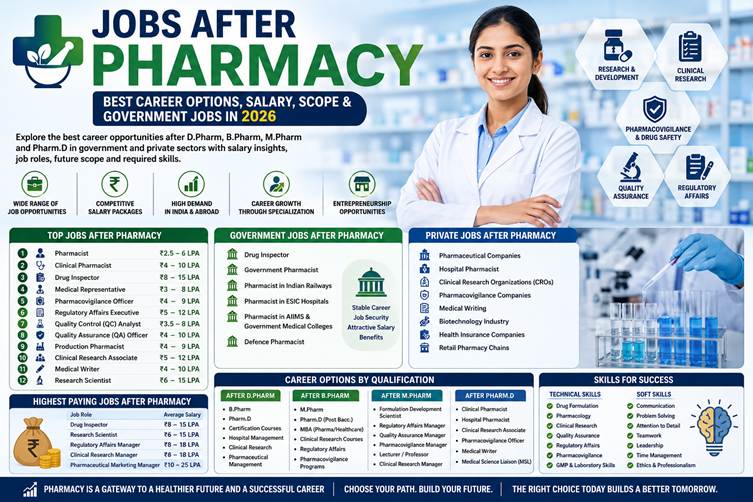
Top Jobs After Pharmacy
After completing a pharmacy course, graduates can choose from numerous career opportunities depending on their qualification, specialization, skills, and interests. Below are some of the most popular and rewarding pharmacy careers.
1. Pharmacist
A Pharmacist is one of the most common and respected career choices after pharmacy. Pharmacists dispense prescribed medicines, educate patients about proper medication usage, monitor drug interactions, and ensure patient safety.
Average Salary
₹2.5–6 LPA
2. Clinical Pharmacist
Clinical pharmacists work closely with doctors and healthcare teams to improve patient treatment outcomes. Their primary role is to ensure that medications prescribed to patients are safe, effective, and appropriate.
Average Salary
₹4–10 LPA
3. Drug Inspector
A Drug Inspector is considered one of the most prestigious government jobs after Pharmacy. They ensure that medicines manufactured and sold meet legal quality standards.
Average Salary
₹8–15 LPA
4. Medical Representative
Medical Representatives act as the bridge between pharmaceutical companies and healthcare professionals. They promote medicines, explain product benefits, and help increase product awareness among doctors.
Average Salary
₹3–8 LPA
5. Pharmacovigilance Officer
Pharmacovigilance professionals monitor the safety of medicines after they reach the market. They identify, assess, and report adverse drug reactions to ensure patient safety.
Average Salary
₹4–9 LPA
6. Regulatory Affairs Executive
Every medicine must comply with national and international regulations before reaching the market. Regulatory Affairs Executives manage documentation, approvals, and compliance throughout the product lifecycle.
Average Salary
₹5–12 LPA
7. Quality Control (QC) Analyst
Quality Control Analysts ensure that medicines meet strict quality standards before they are released for public use.
Average Salary
₹3.5–8 LPA
8. Quality Assurance (QA) Officer
Quality Assurance professionals focus on maintaining manufacturing standards and ensuring that every stage of medicine production follows Good Manufacturing Practices (GMP).
Average Salary
₹4–10 LPA
9. Production Pharmacist
Production Pharmacists supervise the manufacturing of medicines while ensuring safety, efficiency, and quality standards.
Average Salary
₹4–9 LPA
10. Clinical Research Associate (CRA)
Clinical Research Associates monitor clinical trials conducted to evaluate new medicines and medical treatments.
Average Salary
₹5–12 LPA
11. Medical Writer
Medical Writers create scientific and healthcare-related documents for pharmaceutical companies, healthcare organizations, journals, and research institutions.
Average Salary
₹4–10 LPA
12. Research Scientist
Research Scientists work on developing innovative medicines, improving existing formulations, and advancing pharmaceutical science.
Average Salary
₹6–15 LPA
Government Jobs After Pharmacy
Pharmacy graduates can apply for government jobs in hospitals, public health departments, and regulatory agencies through various recruitment exams.
1. Drug Inspector
Drug Inspectors ensure that medicines manufactured, distributed, and sold meet the standards laid down by the government. They inspect pharmaceutical manufacturing units, warehouses, pharmacies, and laboratories to ensure compliance with drug safety regulations.
Average Salary: ₹8–15 LPA
2. Government Pharmacist
Government Pharmacists work in public hospitals, district hospitals, primary health centres (PHCs), community health centres (CHCs), railway hospitals, military hospitals, and other government healthcare institutions.
Average Salary: ₹4–8 LPA
3. Pharmacist in Indian Railways
The Indian Railways regularly recruits pharmacists to provide pharmaceutical services to railway employees and their families.
Average Salary: ₹5–9 LPA
4. Pharmacist in ESIC Hospitals
Employees’ State Insurance Corporation (ESIC) hospitals recruit pharmacy professionals to support healthcare services provided to insured workers.
Average Salary: ₹5–8 LPA
5. Pharmacist in AIIMS and Government Medical Colleges
Institutions such as AIIMS and state government medical colleges recruit pharmacists for hospital pharmacies and specialized healthcare departments.
Average Salary: ₹5–9 LPA
6. Defence Pharmacist
The Indian Armed Forces recruit pharmacy graduates for military hospitals and healthcare units.
Average Salary: ₹6–10 LPA
Top Government Recruiters
Some of the major government organizations hiring pharmacy graduates include:
- AIIMS
- ESIC Hospitals
- Indian Railways
- Defence Services
- State Health Departments
Private Jobs After Pharmacy
Private-sector pharmacy jobs offer faster career growth, performance-based promotions, global opportunities, and competitive salary packages.
Below are some of the best private career options after pharmacy.
- Pharmaceutical Companies
Leading pharmaceutical companies hire pharmacy graduates in multiple departments such as:
- Production
- Research & Development
- Quality Assurance
- Quality Control
- Regulatory Affairs
- Pharmacovigilance
- Marketing
- Sales
- Medical Affairs
- Hospital Pharmacist
Private hospitals require pharmacists to manage medicines, counsel patients, and coordinate with doctors to ensure safe medication practices.
Average Salary: ₹3.5–8 LPA
- Clinical Research Organizations (CROs)
Pharmacy graduates can work as:
- Clinical Research Associate
- Clinical Trial Coordinator
- Clinical Data Associate
- Safety Associate
- Pharmacovigilance Companies
Professionals in this field monitor adverse drug reactions, analyze safety data, and ensure medicines remain safe after launch.
- Medical Writing
Medical writers prepare:
- Clinical study reports
- Regulatory documents
- Patient education materials
- Scientific articles
- Medical website content
- Drug information leaflets
- Biotechnology Industry
Biotechnology companies recruit pharmacy graduates for research and product development.
- Health Insurance Companies
Pharmacy professionals review medical claims and prescriptions.
- Retail Pharmacy Chains
Retail pharmacists manage medicine dispensing, inventory, and customer counseling.
Highest Paying Jobs After Pharmacy
Below are some of the highest-paying pharmacy careers.
| Job Role | Average Salary |
| Drug Inspector | ₹8–15 LPA |
| Research Scientist | ₹6–15 LPA |
| Regulatory Affairs Manager | ₹8–18 LPA |
| Clinical Research Manager | ₹8–18 LPA |
| Pharmacovigilance Manager | ₹8–16 LPA |
| Medical Writer | ₹4–10 LPA |
| Clinical Pharmacist | ₹4–10 LPA |
| QA Manager | ₹8–18 LPA |
| Production Manager | ₹8–20 LPA |
| Pharmaceutical Marketing Manager | ₹10–25 LPA |
Best Career Options After D.Pharm
Popular options include:
- B.Pharm
- Pharm.D
- Certification courses
- Hospital management
- Clinical research programs
- Pharmaceutical management
Best Career Options After B.Pharm
Popular options include:
- M.Pharm
- Pharm.D (Post Baccalaureate)
- MBA in Pharmaceutical Management
- MBA in Healthcare Management
- Clinical Research Courses
- Regulatory Affairs Certification
- Pharmacovigilance Programs
Best Career Options After M.Pharm
- Formulation Development Scientist
- Regulatory Affairs Manager
- Quality Assurance Manager
- Pharmacovigilance Manager
- Lecturer or Professor
- Clinical Research Manager
Best Career Options After Pharm.D
- Clinical Pharmacist
- Hospital Pharmacist
- Clinical Research Associate
- Pharmacovigilance Officer
- Medical Writer
- Drug Safety Associate
- Medical Science Liaison (MSL)
Salary After Pharmacy in India
Below is a general salary overview:
| Qualification | Average Starting Salary |
| D.Pharm | ₹2–4 LPA |
| B.Pharm | ₹3–6 LPA |
| M.Pharm | ₹5–10 LPA |
| Pharm.D | ₹4–10 LPA |
Skills Required for a Successful Pharmacy Career
Technical Skills
- Drug formulation knowledge
- Pharmacology
- Pharmaceutical chemistry
- Clinical research
- Quality assurance
- Regulatory affairs
- Pharmacovigilance
- Good Manufacturing Practices (GMP)
- Laboratory techniques
Soft Skills
- Communication skills
- Problem-solving ability
- Critical thinking
- Attention to detail
- Teamwork
- Leadership
- Time management
- Ethics and professionalism
- Computer proficiency
Future Scope of Pharmacy
Pharmacy offers excellent long-term career opportunities due to the growing healthcare and pharmaceutical industries. Demand for skilled professionals continues to increase in hospitals, pharmaceutical companies, research organizations, government departments, and biotechnology firms.
Frequently Asked Questions (FAQs)
1. What are the best jobs after Pharmacy?
Some of the best jobs after Pharmacy include Pharmacist, Drug Inspector, Clinical Pharmacist, Medical Representative, Quality Assurance Officer, Clinical Research Associate, Regulatory Affairs Executive, and Pharmacovigilance Officer.
2. Can I get a government job after B.Pharm?
Yes. B.Pharm graduates can apply for government positions such as Drug Inspector, Government Pharmacist, Pharmacist in AIIMS, ESIC, Indian Railways, Defence Services, and State Health Departments, depending on the eligibility criteria.
3. What is the average salary after Pharmacy in India?
The average starting salary ranges from ₹2–4 LPA for D.Pharm, ₹3–6 LPA for B.Pharm, ₹5–10 LPA for M.Pharm, and ₹4–10 LPA for Pharm.D. Salaries increase with experience, specialization, and employer.
4. Is Pharmacy a good career in 2026?
Yes. Pharmacy remains one of the fastest-growing healthcare professions due to increasing demand for medicines, clinical research, pharmaceutical manufacturing, and patient care. It offers stable career growth in both government and private sectors.
Conclusion
Pharmacy is a dynamic and rewarding field that offers a wide range of career opportunities across healthcare, research, manufacturing, and government sectors. Whether you have completed D.Pharm, B.Pharm, M.Pharm, or Pharm.D, you can choose from roles such as Pharmacist, Drug Inspector, Clinical Research Associate, Medical Writer, Quality Assurance Officer, or Regulatory Affairs Executive based on your interests and qualifications.
As the pharmaceutical industry continues to evolve, skilled pharmacy professionals will remain in high demand in India and globally. By developing the right technical knowledge and practical skills, you can build a successful and fulfilling career after pharmacy.
If you’re planning your future, explore different career paths, identify your strengths, and choose the option that aligns with your long-term goals. The right decision today can help you build a successful career in the ever-growing healthcare industry.