
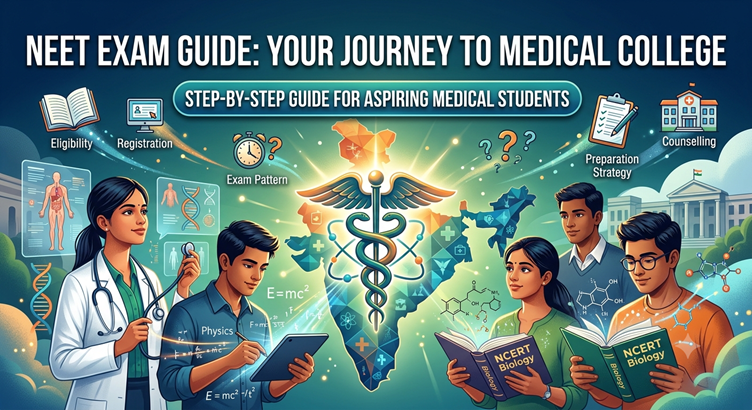
Introduction
Becoming a doctor is a dream shared by millions of students in India. Turning that dream into reality requires dedication, careful planning, and the right guidance. If you want to pursue an MBBS, BDS, AYUSH, or other undergraduate medical course in India, the first and most important step is to appear for the National Eligibility cum Entrance Test (NEET). Every year, millions of students compete in this highly competitive examination, making it essential to understand the entire process before starting your preparation.
Many NEET aspirants have common questions, such as: How to appear for the NEETexam?, Who is eligible for NEET?, How do I register for the exam?, and What should I do afterqualifying? Knowing the answers to these questions can help you avoid common mistakes and make your journey smoother.
The NEET exam is conducted once a year and serves as the gateway to admission into medical, dental, AYUSH, veterinary, nursing, and several other healthcare programs offered by government and private institutions across India. Since the competition is intense, simply preparing for the syllabus is not enough. You must also understand the eligibility criteria, registration process, required documents, exam pattern, preparation strategy, and counselling procedure.
This comprehensive guide explains every stage of appearing for the NEET exam in a simple and easy-to-understand manner. Whether you are studying in Class 11, Class 12, or taking a gap year to prepare, this article will help you confidently navigate the complete NEET journey—from checking your eligibility to securing admission into your dream medical college.
What is the NEET Exam?
The National Eligibility cum Entrance Test (NEET-UG) is India’s single entrance examination for undergraduate medical courses. It is conducted annually for students seeking admission to courses such as:
- MBBS (Bachelor of Medicine and Bachelor of Surgery)
- BDS (Bachelor of Dental Surgery)
- BAMS (Bachelor of Ayurvedic Medicine and Surgery)
- BHMS (Bachelor of Homeopathic Medicine and Surgery)
- BUMS (Bachelor of Unani Medicine and Surgery)
- BSMS (Bachelor of Siddha Medicine and Surgery)
- Veterinary and Animal Husbandry courses
- B.Sc. Nursing (in participating institutions)
- Other allied medical programs
The NEET exam assesses candidates’ understanding of Physics, Chemistry, and Biology based on the Class 11 and Class 12 syllabus.
Why is NEET Important?
NEET has become the standard entrance examination for medical admissions across India. Instead of appearing for multiple entrance exams, students now need to qualify for only one national-level examination.
Some major advantages include:
- One exam for medical admissions across India.
- Transparent and merit-based selection process.
- Admission opportunities in government and private colleges.
- Acceptance by several prestigious medical institutions.
- Opportunity to study various healthcare courses beyond MBBS.
A good NEET score can significantly increase your chances of securing admission to a reputed medical college.
Who Can Appear for the NEET Exam?
Before applying, students must ensure they meet the eligibility requirements.
Educational Qualification
Candidates should have completed or be appearing in Class 12 with the following subjects:
- Physics
- Chemistry
- Biology/Biotechnology
- English
Students appearing for their Class 12 board examinations are also eligible to apply, provided they satisfy the required qualifying criteria during admission.
Minimum Qualifying Marks
Different categories have different minimum qualifying requirements in the qualifying examination. Students should always refer to the latest official information before applying.
Age Criteria
Candidates must meet the minimum age requirement specified for the examination at the time of admission.
Nationality
The following candidates can generally apply:
- Indian Citizens
- Non-Resident Indians (NRIs)
- Overseas Citizens of India (OCI)
- Persons of Indian Origin (PIO), where applicable
- Foreign Nationals
Always verify the latest eligibility guidelines before submitting your application.
Step-by-Step Process to Appear for the NEET Exam
Understanding the complete registration process can help you avoid unnecessary mistakes.
Step 1: Check the Official Notification
The first step is to carefully read the official information bulletin released before the application process begins.
The notification includes:
- Eligibility criteria
- Registration dates
- Exam schedule
- Required documents
- Fee details
- Examination rules
Reading the notification carefully helps students avoid application rejection due to incorrect information.
Step 2: Register Online
Students must register through the official NEET application portal.
During registration, candidates generally provide:
- Name
- Date of Birth
- Mobile Number
- Email Address
- Identification details
After successful registration, login credentials are generated.
Keep these login credentials safe throughout the admission process.
Step 3: Fill the Application Form
The application form requires accurate personal and academic details.
Information generally includes:
- Personal information
- Parent details
- Educational qualifications
- Category
- Examination centre preferences
- Communication address
Double-check every entry before proceeding.
Incorrect details may create issues during counselling and admission.
Step 4: Upload Required Documents
Candidates are required to upload scanned copies of specified documents.
Commonly required documents include:
- Passport-size photograph
- Signature
- Left-hand thumb impression (if applicable)
- Category certificate (if applicable)
- PwD certificate (if applicable)
- Identity proof, where required
Ensure that all files meet the prescribed format and size requirements.
Step 5: Pay the Application Fee
The application process is completed only after successful payment of the examination fee.
Payment can usually be made using:
- Debit Card
- Credit Card
- Net Banking
- UPI
- Other approved online payment methods
Save the payment confirmation and receipt for future reference.
Step 6: Download the Confirmation Page
After submitting the application successfully:
- Download the confirmation page.
- Save a digital copy.
- Print multiple copies for future use.
This document serves as proof that your application has been submitted successfully.
Documents Required for NEET Registration
Keeping all documents ready before registration makes the process smooth.
Some important documents include:
- Aadhaar Card or other accepted identity proof
- Class 10 certificate
- Class 12 details
- Passport-size photograph
- Signature
- Email ID
- Mobile number
- Category certificate (if applicable)
- Income certificate (where required)
- PwD certificate (if applicable)
Organize all the required documents well in advance to avoid last-minute problems.
Understanding the NEET Exam Pattern
Knowing the exam pattern is just as important as studying the syllabus.
The NEET examination includes questions from:
- Physics
- Chemistry
- Botany
- Zoology
Questions are objective-type multiple-choice questions (MCQs).
The examination is conducted offline using an OMR answer sheet.
Before appearing for the exam, students should understand:
- Total duration
- Number of questions
- Marking scheme
- Negative marking rules
Regularly practising mock tests using the same format improves confidence and time management.
NEET Syllabus
The syllabus mainly covers topics from Class 11 and Class 12.
Physics
Major areas include:
- Mechanics
- Thermodynamics
- Optics
- Current Electricity
- Modern Physics
Chemistry
Important sections include:
- Physical Chemistry
- Organic Chemistry
- Inorganic Chemistry
Biology
Biology carries the highest weightage.
Important topics include:
- Human Physiology
- Genetics
- Ecology
- Cell Biology
- Plant Physiology
- Biotechnology
- Reproduction
- Evolution
A thorough understanding of NCERT textbooks is highly recommended, as many questions are directly based on these concepts.
How to Prepare for the NEET Exam
Success in NEET depends on consistent preparation rather than last-minute studying.
Here are some proven preparation strategies:
Create a Study Plan
Develop a realistic timetable that covers all three subjects daily.
Allocate time for:
- Learning new concepts
- Revision
- Mock tests
- Question practice
- Doubt-solving
Following a disciplined schedule helps maintain consistency and reduces stress.
Focus on NCERT Books
NCERT textbooks form the foundation of NEET preparation, especially for Biology and Chemistry.
Study each chapter carefully, revise regularly, and pay close attention to diagrams, definitions, and key concepts.
Practice Previous Years’ Question Papers
Solving previous years’ papers helps you understand:
- Question patterns
- Frequently asked topics
- Difficulty level
- Time management
It also boosts confidence and prepares you for the actual examination.
Take Regular Mock Tests
Mock tests are one of the most effective ways to prepare for the NEET exam. They simulate the actual examination environment and help you become familiar with the question pattern, marking scheme, and time constraints. Initially, you may find it difficult to complete the paper within the allotted time, but regular practice gradually improves both speed and accuracy.
After every mock test, spend time analyzing your performance. Identify the topics where you scored well and those that need improvement. Instead of simply checking your score, understand why you made mistakes and revise those concepts thoroughly. Consistent practice with mock tests not only boosts confidence but also helps reduce exam-day anxiety.
Revise Regularly
Regular revision is the key to retaining what you have learned.Many students focus only on completing the syllabus but forget to revise it, which often leads to poor performance during the exam.
A good revision strategy includes:
- Revising important formulas every week.
- Going through Biology diagrams regularly.
- Reviewing Chemistry reactions and equations.
- Solving previously attempted questions.
- Maintaining short notes for quick revision.
Frequent revision ensures that concepts remain fresh in your memory and improves long-term retention.
Improve Time Management
Time management plays a crucial role in NEET preparation. Since the exam contains a large number of questions to be answered within a limited time, students should learn how to allocate their time efficiently.
Some useful time management tips include:
- Study difficult subjects during your most productive hours.
- Divide long study sessions into smaller blocks.
- Set daily and weekly study goals.
- Avoid spending too much time on a single question during practice tests.
- Reserve time every week for revision.
Developing good time management skills during preparation will help you remain calm and focused during the actual examination.
Common Mistakes to Avoid During NEET Preparation
Many students work hard but fail to achieve their desired score because of avoidable mistakes. Being aware of these mistakes can help you prepare more effectively.
Ignoring NCERT Textbooks
Some students spend most of their time studying advanced reference books while neglecting NCERT textbooks. Since many NEET questions are directly based on NCERT concepts, this approach can be costly.
Lack of Revision
Studying new topics without revising previously learned concepts weakens retention. Regular revision is essential for success.
Skipping Mock Tests
Mock tests help identify strengths and weaknesses. Students who avoid them often struggle with time management during the actual exam.
Poor Time Management
Studying without a structured timetable leads to inconsistent preparation and incomplete syllabus coverage.
Not Analyzing Mistakes
Simply solving questions is not enough. Every incorrect answer should be reviewed to understand the reason behind the mistake.
Studying for Long Hours Without Breaks
Continuous studying without proper breaks reduces concentration and productivity. Short breaks help refresh the mind and improve learning efficiency.
NEET Exam Day Guidelines
The day of the examination is just as important as months of preparation. Following the official guidelines helps ensure a smooth experience.
Before leaving for the examination centre, make sure you carry:
- Admit Card
- Valid identity proof
- Passport-size photograph (if required)
- Any other documents mentioned in the admit card instructions
Students should also remember the following:
- Reach the examination centre well before the reporting time.
- Follow the prescribed dress code.
- Avoid carrying prohibited items such as electronic gadgets, smartwatches, calculators, notes, or study material.
- Listen carefully to the invigilator’s instructions.
- Fill in the OMR sheet carefully and double-check your details before submitting it.
Remaining calm and focused during the examination can significantly improve your performance.
What Happens After the NEET Exam?
Appearing for the examination is only one part of the admission process. After the exam, several important stages follow.
Result Declaration
Once the examination is completed, the conducting authority evaluates the answer sheets and publishes the results online. Candidates can check their scorecards using their application credentials.
The result generally includes:
- Total marks obtained
- Subject-wise scores
- Percentile
- All India Rank
- Qualifying status
Students should download and save multiple copies of their scorecard for future use.
Merit List
Based on the examination results, merit lists are prepared for different categories. Your rank determines your eligibility for various counselling rounds and colleges.
A higher rank increases your chances of securing admission to a government medical college.
NEET Counselling Process
Qualifying for NEET does not automatically guarantee admission. Eligible candidates must participate in the counselling process to secure a seat.
The counselling process generally involves the following steps:
Step 1: Registration
Candidates register for counselling through the designated counselling authority.
Step 2: Choice Filling
Students select their preferred:
- Medical colleges
- Courses
- States
- Institutions
It is advisable to list choices carefully based on rank, preference, and previous years’ cut-offs.
Step 3: Seat Allotment
Seats are allotted based on:
- NEET rank
- Category
- Reservation policy
- Seat availability
- Candidate preferences
Step 4: Document Verification
Selected candidates must present their original documents for verification.
Commonly required documents include:
- NEET scorecard
- Admit card
- Class 10 certificate
- Class 12 marksheet
- Identity proof
- Passport-size photographs
- Category certificate (if applicable)
Step 5: Reporting to the College
After successful verification, candidates report to the allotted college within the specified deadline to complete the admission formalities.
Tips to Score Well in the NEET Exam
Scoring high in NEET requires a combination of smart preparation, discipline, and consistency.
Here are some practical tips:
- Study every day instead of relying on last-minute preparation.
- Build a strong understanding of concepts rather than memorizing answers.
- Revise Biology regularly, as it carries the highest weightage.
- Practice numerical problems in Physics daily.
- Strengthen Organic and Physical Chemistry concepts through regular practice.
- Solve previous years’ question papers.
- Take full-length mock tests every week.
- Maintain a healthy diet and proper sleep schedule.
- Stay physically active to improve concentration.
- Believe in your preparation and stay positive throughout the journey.
Frequently Asked Questions
Can I appear for NEET after Class 12?
Yes. Students who have completed or are appearing in Class 12 with the required subjects can apply for the NEET exam, provided they meet the prescribed eligibility criteria.
Is NEET compulsory for MBBS admission?
Yes. NEET is the mandatory entrance examination for admission to MBBS courses in India.
How many times can I appear for NEET?
Eligible candidates can appear for the examination according to the latest rules announced by the conducting authority.
Is Biology the most important subject in NEET?
Yes. Biology generally carries the highest weightage in the examination, making it one of the most important subjects for scoring well.
Can I prepare for NEET without coaching?
Yes. Many students qualify for NEET through self-study by following NCERT textbooks, practicing mock tests, solving previous years’ papers, and maintaining a disciplined study schedule.
Final Checklist Before Appearing for NEET
Before the examination, ensure that you have completed the following:
- Verified your eligibility.
- Completed the online registration.
- Submitted the application form correctly.
- Uploaded all required documents.
- Paid the application fee.
- Downloaded the confirmation page.
- Downloaded the admit card.
- Revised the complete syllabus.
- Practiced mock tests.
- Packed all required documents for exam day.
Completing this checklist can help reduce stress and ensure that you are fully prepared for the examination.
Conclusion
Appearing for the NEET exam is the first major milestone toward building a successful career in medicine. While the competition is challenging, proper planning, disciplined preparation, and a clear understanding of the examination process can significantly improve your chances of success.
Begin by checking the eligibility criteria, completing the registration process carefully, and understanding the exam pattern and syllabus. Build a realistic study plan, focus on NCERT textbooks, revise consistently, and regularly practice mock tests and previous years’ question papers. Avoid common mistakes, manage your time effectively, and stay confident throughout your preparation.
Remember that success in NEET is not determined by the number of hours you study but by the quality and consistency of your preparation. Every small step you take today brings you closer to your dream of becoming a doctor.
If you found this guide helpful, bookmark it for future reference and share it with friends or classmates who are also preparing for NEET. Staying informed and preparing strategically can make your medical journey smoother and increase your chances of securing admission to your dream college.


Leave a Comment